By Kent Miller
CORRESPONDENT
Published: November 6, 2014 12:04 pm ET
Updated: November 6, 2014 12:11 pm ET
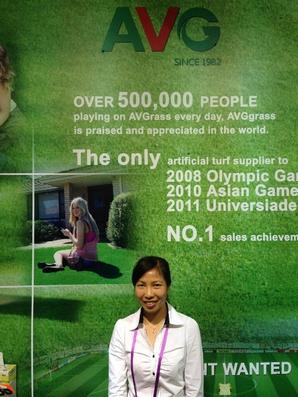
Image By: Kent Miller
Arid regions are big customers for All Victory Grass, said Janet Huang.
GUANGZHOU — Trying to stay one step ahead of the competition, savvy players in China’s burgeoning artificial turf sector are making the plunge into overseas markets.
Domestic purchases remain strong, fueled by a boom in sports fields for elementary, middle and high schools, multiple vendors at the Guangzhou’s Canton Fair Phase II told Plastics News China.
Yet competition in the faux-grass field is getting stiffer.
Competition was minimal when Hebei Mighty Synthetic Rubber and Plastics Co. Ltd. (2013 sales: $20 million) was established 10 years ago, but, “Now in China, there are hundreds of manufacturers of artificial grass,” said sales manager Abner Han.
Abroad, demands vary by region. In arid climates, the chief appeal of faux grass is that it’s never thirsty, said Janet Huang, sales manager for All Victory Grass (Guangzhou) Co. Ltd.
“The Middle East market is very big for AVG. We get at least 10 visitors from the Middle East every month.”
In soccer-mad South America, Europe and Africa, thrifty buyers are attracted by the cost savings of a pitch that doesn’t need mowing, chalking or resodding.
“After you install it, there is no maintenance you need to take,” said Ally Lee, sales manager at Guangzhou City Green Athletic Facility Co. Ltd., which markets under the City Green brand.
While artificial turf at the professional sports level has long passed its 1970s-80s heydays, fake grass is still often used for training fields, even at high-profile events. All Victory’s turf was installed in practice venues at the 2008 Olympics, the 2010 Asian Games in Guangzhou and the 2011 Shenzhen Universiade.
Making artificial grass is a three-step process: extruding and spinning the artificial strands, or ‘yarn,’ from polyethylene or a polyethylene/polypropylene blend; gathering the strands into tufts; and finally, applying the backing — usually latex.
Guangzhou City Green has a typical setup — four yarn-making machines, six tufting machines and one backing machine. To meet demand, the closely held company plans to add another back-coating machine.
With the turf required for a typical 7,000-square-meter soccer pitch weighing about 19 tons, shipping is very much a consideration for cost-sensitive customers. For that reason, factories are typically sited near China’s deep-water ports, with the Pearl River Delta a particular hotspot. City Green spins its yarn in a 100,000-square-meter factory in Shishou, Hubei province, with the yarn then being shipped to the company’s 40,000-square-meter tufting and backing factory in Guangzhou on the Pearl River.
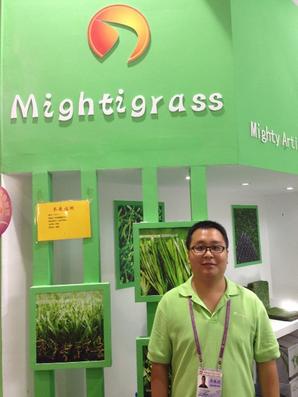
Image By: Kent Miller
Abner Han of Mightigrass.
While virtually every vendor will show off samples of red, yellow or blue turf, green easily remains the color of choice.
U.S. buyers prefer polyurethane backing, which shreds less and lasts longer than latex, says Mighty Synthetic’s Han. With an eye on potential stateside buyers, Mighty Synthetic installed a $500,000 PU-backing machine earlier this year.
It’s money well spent to tap a huge market, Han says.
“American people always have bigger gardens than Europeans.” Artificial turf is particularly popular in the West, where a drought has made real grass impractical in many places.
Vendors can count on repeat buyers, as an installation lasts five to 10 years — less in high-use sports applications and in extreme climates.
Water-savings aside, artificial turf is green in color, not environmental friendliness. Promotional materials make a point of flaunting the use of virgin PE only. Buyers are wary of yarn made with recycled plastics, which may contain heavy metals, says AVG’s Huang.
Once it’s worn out, artificial turf is practically unrecyclable, as separating the strands from the backing is too difficult.
“It’s a problem for this industry,” concedes Mighty Synthetic’s Han.
|